Product Carbon Footprint IT Platforms: From Sustainability Reporting to Business Decision-Making
Product Carbon Footprint (PCF) management is evolving from spreadsheet-based sustainability reporting into a core enterprise business process. This article explores why dedicated PCF platforms are becoming essential for refining, petrochemical, and chemical companies, what capabilities such platforms should deliver, a three-level architecture concept, integration with existing digital systems, and a phased implementation approach.
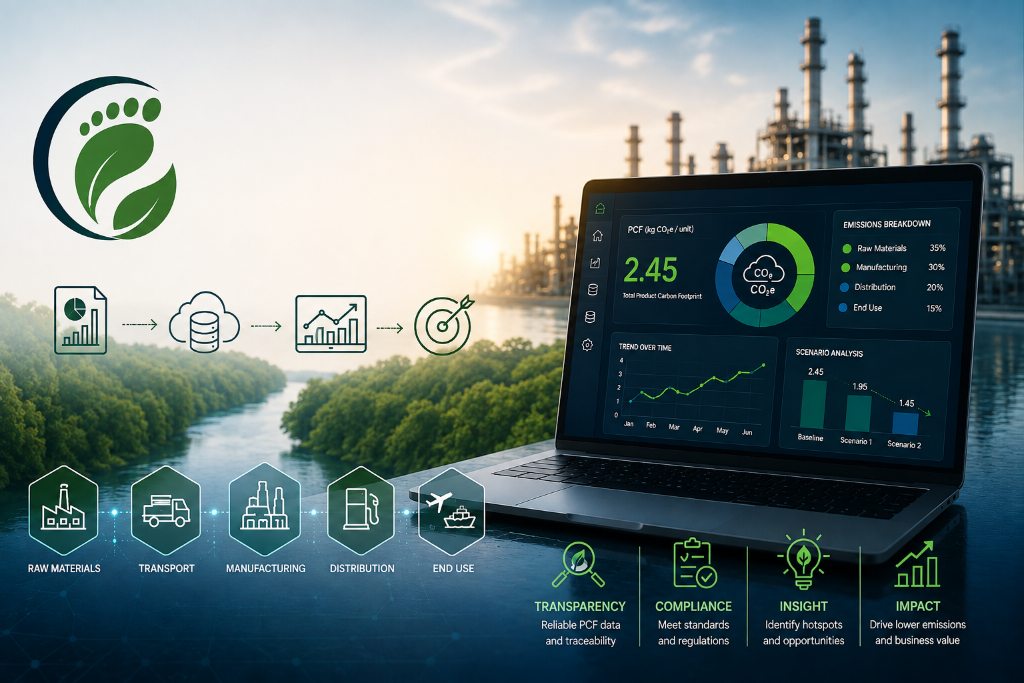
by Dr. Stanislav Koshkin
Why PCF is becoming a business-critical capability
Global industry is experiencing a significant shift toward the measurement, management, and reduction of greenhouse gas emissions.
Governments, regulators, investors, customers, and society increasingly expect companies to demonstrate the environmental performance of both their operations and their products. Sustainability has evolved from a voluntary corporate initiative into a strategic business objective and, for many organizations, a prerequisite for maintaining market competitiveness.
The adoption of the Paris Agreement [1] and the development of national and regional decarbonization policies have accelerated this transition. At the same time, leading global companies such as Nestle, BASF, Unilever, IKEA, and many others have established ambitious targets to reduce greenhouse gas emissions across their value chains.
However, effective emissions reduction begins with accurate measurement.
As with any optimization initiative, organizations must first establish a reliable baseline, identify the main sources of emissions, and prioritize improvement opportunities before corrective actions can be implemented.
This is why the ability to calculate and manage greenhouse gas emissions is becoming a fundamental business capability.
Every product generates emissions throughout its life cycle. Raw materials, utilities, transportation, auxiliary materials, manufacturing processes, and logistics all contribute to the overall environmental impact of the final product.
By quantifying the greenhouse gas emissions generated throughout the product life cycle and allocating them to the quantity of product produced, organizations calculate one of the most important sustainability metrics, Product Carbon Footprint (PCF).
PCF measures the total greenhouse gas emissions associated with a product throughout its life cycle.
At the corporate level, aggregating PCF values across multiple products provides a broader understanding of the company's carbon footprint and supports decision-making related to emissions reduction, product portfolio management, customer requirements, sustainability reporting, and investment planning.
Although the same principles apply across many industries, the need for a dedicated digital solution is particularly relevant for refining, petrochemical, and chemical companies.
Why spreadsheets are no longer enough
For organizations producing a limited number of products through relatively simple manufacturing processes, PCF calculations can initially be performed in Microsoft Excel or similar spreadsheet-based tools.
Such solutions are often sufficient during the early stages of a sustainability program.
The situation is very different in refining and petrochemicals.
These industries operate highly integrated production systems consisting of hundreds of process units, thousands of material and energy streams, multiple utilities, complex recycle systems, and extensive product portfolios.
Calculating PCF for hundreds or even thousands of products requires the continuous collection, validation, reconciliation, and processing of large volumes of operational and business data from multiple facilities.
Under these conditions, spreadsheet-based tools become increasingly difficult to maintain, scale, standardize, and govern.
Enterprise-wide PCF calculation in spreadsheets would require significant manual effort. It would also limit the company's ability to perform calculations regularly, respond quickly to customer requests, maintain consistent methodologies, and provide full traceability for certification and audit purposes.
A similar evolution has already occurred in financial management.
Over time, enterprise resource planning systems such as SAP replaced many fragmented and manual accounting processes. Financial information became standardized, integrated, traceable, and available across the organization.
PCF management is approaching a similar stage of development.
The next step is the creation of a dedicated enterprise PCF platform capable of automating data collection, calculation, validation, reporting, and governance.
The market for such solutions is still developing. Industrial companies and software providers have already launched several initiatives, including collaborations such as BASF [2] with Atos and Dow with BCG [3]. However, comprehensive enterprise-scale PCF platforms remain an emerging technology, and no universally adopted industry-standard solution has yet been established.
This creates an opportunity for industrial companies to develop a scalable digital capability that can be integrated with existing MES, ERP, laboratory, process historian, and sustainability systems.
What should a PCF platform deliver?
A practical PCF platform should support both current business requirements and long-term development.
Its capabilities can therefore be divided into two groups:
- Mandatory capabilities, required to establish a fully operational enterprise PCF calculation system.
- Preferred capabilities, which provide more advanced analytics, optimization, and decision-support functionality.
The mandatory scope should include the automated calculation of PCF for products manufactured at operating facilities and for products expected from future investment projects.
The platform should support manual and automated data collection, validate operational and business information, integrate with enterprise systems, maintain centralized emission factors, support multiple calculation methodologies, generate standardized reports, and provide full calculation traceability.
In this role, the PCF platform becomes the enterprise system of record for Product Carbon Footprint calculations.
The preferred functionality extends the platform beyond reporting.
Over time, the platform may be developed to identify production routes that minimize PCF while satisfying operational and economic constraints. It may support feedstock and auxiliary material optimization, scenario analysis, anomaly detection, and the automated comparison of alternative production and supply-chain configurations.
In this case, the platform evolves from a calculation tool into an intelligent business decision-support system.
The business value goes beyond sustainability reporting
The first and most immediate benefit is a reduction in the engineering effort required to calculate PCF and prepare certification packages.
A platform can also improve the speed of response to customer requests. This may support faster product qualification, reduce the time required to enter new markets, and improve the commercial positioning of products with a lower carbon footprint.
Implementation of a standardized and auditable platform may also simplify certification.
Instead of repeatedly auditing individual calculations for every product, certification bodies may eventually be able to assess the methodology and the digital calculation process implemented within the platform. This could significantly reduce repetitive certification work.
The more advanced capabilities may create additional commercial and strategic value.
For example, the platform may identify technically and economically feasible ways to produce a product with a target PCF. This can support the capture of market premiums associated with lower-carbon products or improve access to customers and regions with stricter environmental requirements.
PCF may also become an additional procurement criterion.
When selecting feedstocks, catalysts, utilities, additives, or other materials, a company may evaluate not only price, quality, and security of supply, but also the embedded greenhouse gas emissions associated with the purchased material.
This strengthens the role of PCF in supplier negotiations and supply-chain management.
Methodology is still evolving
A digital platform cannot be designed without considering the methodological foundation of the calculations.
The most widely recognized frameworks currently include ISO [4] 14040, ISO 14044, ISO 14067, and the GHG Protocol [5]. These standards define high-level principles for Life Cycle Assessment (LCA), greenhouse gas accounting, allocation, and PCF calculation.
They provide an essential common foundation.
However, there is still no universally accepted methodology developed specifically for the refining and petrochemical industries.
This is important because highly integrated production systems create methodological questions that can materially change the final PCF result.
Consider a simplified process with one feed stream and two output streams.
If both outputs are classified as products, emissions may be allocated between them. If one output is classified as waste with no allocated environmental burden, the entire process emissions may be assigned to the remaining product.
The process itself has not changed, but the calculated PCF can be significantly different because a different allocation methodology has been applied.
In integrated refining and petrochemical complexes, such questions become much more complicated.
Should hydrogen produced in a steam-cracking complex be treated as a co-product or as fuel?
Should hydrogen produced in a catalytic reforming unit be treated as a product, a co-product, or an internal utility?
How should emissions be allocated in an aromatics complex with multiple recycle streams and intermediate products?
These are not minor technical questions. They directly affect the calculated carbon footprint of final products.
Industry initiatives such as the Together for Sustainability [6] PCF Guideline are moving toward more prescriptive guidance for chemicals. Leading companies including BASF and Dow have also developed internal methodologies to support their carbon accounting and digital solutions.
However, until a broadly accepted industry methodology is established, a PCF platform should not be rigidly connected to one calculation approach.
It should support configurable allocation rules, calculation parameters, and multiple methodologies. This flexibility is essential to keep the platform aligned with future standards, customer requirements, and regulatory developments.
A three-level platform concept
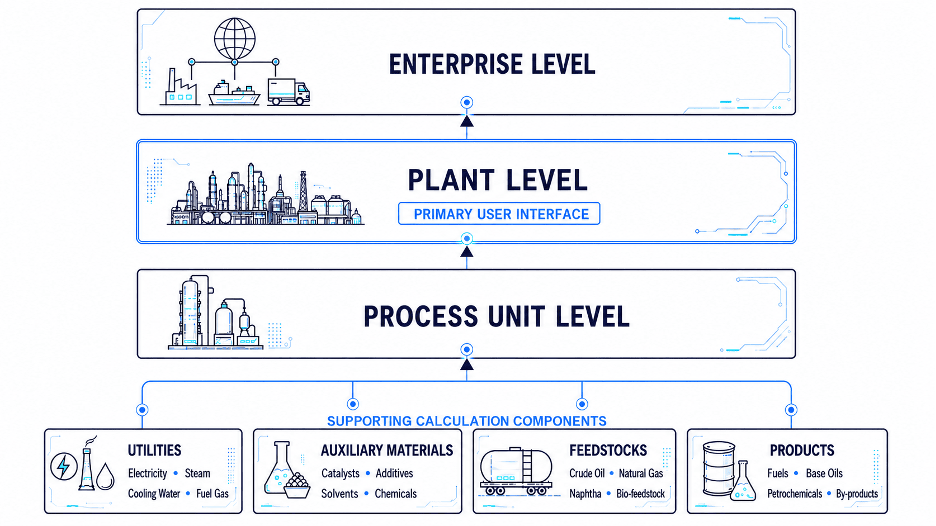
A practical PCF platform for a large industrial company can be structured around three hierarchical levels:
- Process Unit Level
- Plant Level
- Enterprise Level
This structure reflects the way industrial companies manage their operations and enables PCF analysis from the level of an individual process unit to the complete corporate supply chain.
Process Unit Level
The Process Unit Level is the fundamental calculation layer.
At this level, the platform collects operational and business information related to feedstocks, products, utilities, auxiliary materials, material balances, and energy consumption.
The platform calculates PCF for the products produced by the unit and provides visibility into the main sources of attributable greenhouse gas emissions.
It should support different allocation methods, including mass-based and energy-based allocation, as well as the appropriate treatment of commercial products, co-products, by-products, intermediate streams, and waste.
The Process Unit Level also provides the detailed traceability required to understand how a product's PCF was calculated.
Plant Level
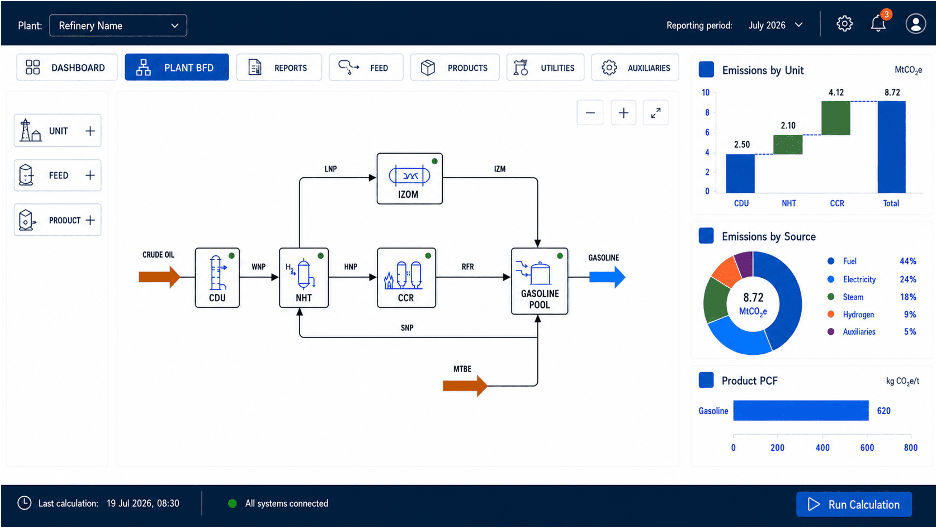
The Plant Level integrates individual process units into a complete manufacturing facility.
This level should represent the production chain through an interactive block flow diagram or process flow structure.
Users should be able to visualize how feedstocks are transformed across multiple units, how intermediate products move through the facility, where utilities are consumed or generated, and how emissions are transferred along the production chain.
The Plant Level should serve as the primary user interface.
It provides the main workspace where users can build, maintain, and analyze the production chain of an individual product or the complete manufacturing site.
It may also provide dashboards covering PCF, greenhouse gas emissions, utilities, energy consumption, and other key indicators.
Enterprise Level
The Enterprise Level extends the calculation boundary beyond one plant.
It combines manufacturing sites, logistics centers, transportation routes, distribution systems, and customer markets.
At its simplest, this level may function as a corporate reporting and analytics layer that aggregates PCF information from multiple sites.
At a more advanced stage, it may become an optimization platform.
For example, two sites may produce the same product with different PCFs due to differences in energy sources, process efficiency, feedstock quality, logistics, and transportation routes.
The platform could determine which plant should supply a specific customer or geographic market to minimize delivered PCF.
However, the lowest-PCF route may not always generate the highest business value.
A more advanced optimization model may balance PCF with production costs, transportation costs, market prices, capacity constraints, contractual obligations, customer specifications, and regional regulations.
A lower-PCF product may be allocated to a market with strict carbon requirements, while a higher-PCF product may be supplied to a region where carbon requirements are less stringent and commercial margins are stronger.
This is where PCF management becomes directly connected to enterprise strategy.
Supporting calculation components
In addition to the three platform levels, the solution should maintain standardized components for:
- Utilities
- Auxiliary materials
- Feedstocks
- Products
The utilities component should manage steam, electricity, cooling water, compressed air, industrial gases, fuel gas, hydrogen, and other utilities.
The auxiliary-materials component should maintain catalysts, additives, solvents, chemicals, reagents, adsorbents, and other production consumables.
The feedstock component should store origin, supplier, transportation characteristics, physical properties, and PCF information for purchased raw materials.
The products component should serve as the central registry of finished products, intermediate products, and by-products, together with their calculation settings, reporting parameters, and PCF values.
Together, these components create a standardized calculation foundation across the enterprise.
Integration with the existing digital landscape
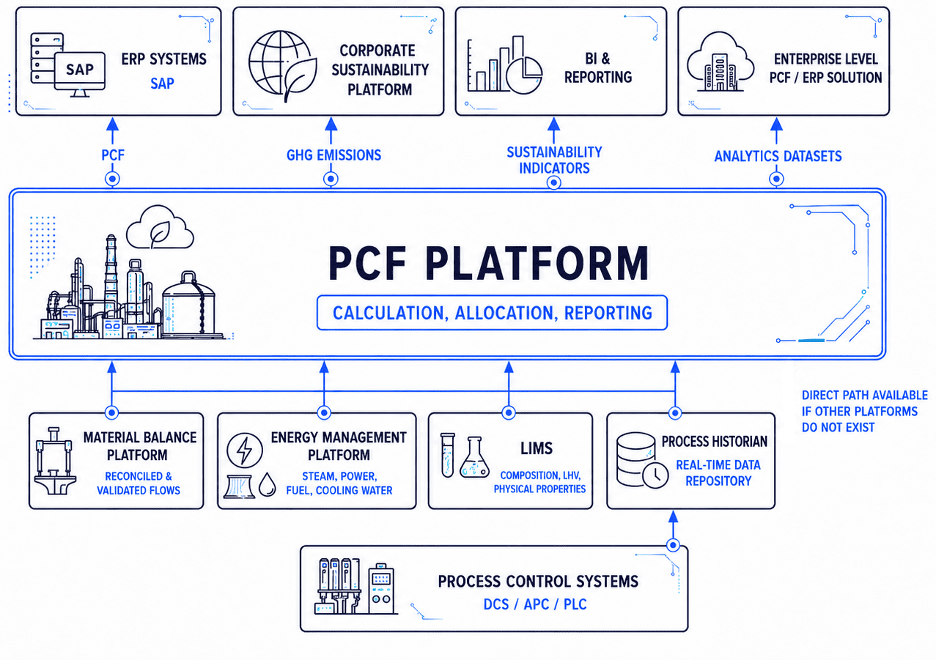
A PCF platform should not operate as an isolated application.
In an automated environment, it should receive operational and business data from existing enterprise systems.
At the plant level, process data typically originate in the Distributed Control System and are stored in the Process Historian.
Material flow rates may be obtained from a material-balance platform, where operational measurements have already been validated and reconciled.
Information on steam, electricity, fuel gas, and other utilities may be received from an energy-management platform.
Product composition, lower heating values, and other laboratory data may be obtained from LIMS.
Where these systems are not available, the PCF platform may receive data directly from the Process Historian or through manual input.
The platform should also provide calculated PCFs, greenhouse gas emissions, and analytical datasets to higher-level systems such as SAP, corporate sustainability platforms, business intelligence tools, and reporting applications.
However, the level of integration should reflect the company's actual digital maturity.
A fully integrated architecture requires significant investment in data governance, system integration, and IT infrastructure. It is not necessary for every organization to begin with the most advanced solution.
A phased implementation approach
The recommended approach is to develop the platform progressively.
The first stage is the development or adoption of a practical PCF calculation methodology.
This methodology does not need to be perfect before software development begins. It will naturally evolve during implementation and should develop in parallel with the platform.
The next stage is the preparation of functional and technical requirements and the development of the first platform version.
The initial release should focus on mandatory capabilities.
Once this version is available, the organization should conduct a pilot implementation at one selected manufacturing site. The pilot allows the company to test the platform under real operating conditions, improve functionality, refine the implementation process, and further develop the underlying calculation methodology.
Following a successful pilot, the solution can be deployed across additional sites in waves.
Advanced integration, enterprise-level optimization, artificial intelligence, and other preferred capabilities can be introduced later as business requirements and organizational maturity evolve.
For many companies, a manually maintained platform with strong governance may remain an economically attractive and fully sufficient solution.
The objective should not be maximum automation from the first day.
The objective should be to establish a reliable, scalable, and useful enterprise capability.
Final thoughts
Product Carbon Footprint management is moving from a sustainability-reporting exercise toward a core business process.
For refining, petrochemical, and chemical companies, the scale and complexity of the challenge make fragmented spreadsheet solutions increasingly difficult to sustain.
A dedicated PCF platform can provide a standardized, traceable, and scalable foundation for calculation, certification, reporting, optimization, and decision-making.
The architecture proposed in this article is not intended to serve as a final software specification. Each company will require a solution adapted to its business objectives, organizational structure, calculation methodology, IT landscape, and level of digital maturity.
However, the overall direction is becoming increasingly clear.
Organizations should begin with essential PCF calculation and reporting capabilities, then progressively expand toward enterprise integration, advanced analytics, and optimization.
Ultimately, the success of a PCF platform should not be measured only by its ability to calculate emissions accurately.
It should also be measured by its contribution to operational efficiency, faster product certification, improved customer confidence, better commercial decisions, more effective portfolio management, and the long-term competitiveness of the organization.
In the future, Product Carbon Footprint may become as fundamental a product characteristic as density, purity, sulfur content, or octane number.
The question is no longer whether industrial companies will need dedicated PCF management capabilities.
The question is how quickly they will build them.
References
- Paris Agreement, United Nations Framework Convention on Climate Change: https://unfccc.int/process-and-meetings/the-paris-agreement
- Atos and BASF — Digital Solution for Product Carbon Footprints: https://atos.net/en/2021/press-release_2021_08_19/atos-develops-digital-solution-to-calculate-product-carbon-footprints-within-the-chemical-industry-in-partnership-with-basf
- BCG — Using a Carbon Footprint Ledger to Unlock Revenue: https://www.bcg.com/about/client-impact/using-a-carbon-footprint-ledger-to-unlock-revenue
- ISO Standards: https://www.iso.org/standards.html
- GHG Protocol Standards and Guidance: https://ghgprotocol.org/standards-guidance
- Together for Sustainability Initiative: https://www.tfs-initiative.com/
Abbreviations
| Abbreviation | Full Form |
|---|---|
| APC | Advanced Process Control |
| BFD | Block Flow Diagram |
| BI | Business Intelligence |
| DCS | Distributed Control System |
| ERP | Enterprise Resource Planning |
| GHG | Greenhouse Gas |
| ISO | International Organization for Standardization |
| IT | Information Technology |
| LCA | Life Cycle Assessment |
| LIMS | Laboratory Information Management System |
| MES | Manufacturing Execution System |
| PCF | Product Carbon Footprint |
| PFD | Process Flow Diagram |
| PLC | Programmable Logic Controller |
Download
📄 Download the full Concept Design PDF
Product Carbon Footprint IT Platform — Concept Design by Dr. Stanislav Koshkin (PDF, 20 pages)